

What to Do With Your Child’s School Papers
Empty the backpack each day. Handle forms that need a signature or reply first. Then choose a few papers to keep, display, or photograph. Recycle routine worksheets and duplicate handouts. Once a week, clear the display area and put the best keepsakes in a labeled file for your child.
You do not need to save every page to remember this stage of their life. A small collection of work that shows their growth and personality is easier to enjoy than a pile you never open.
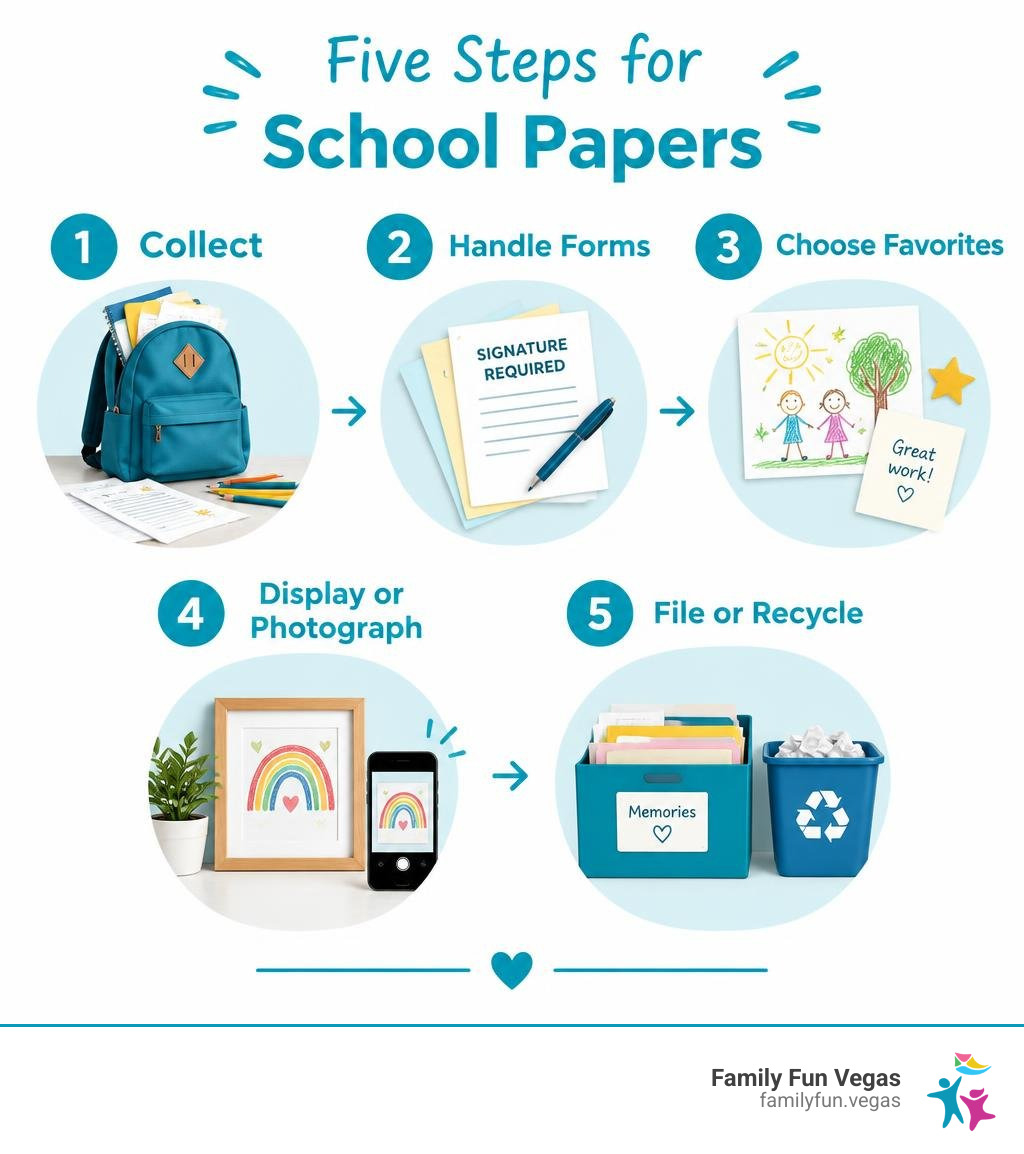
Learn more about what do you do with all of the school papers from your child:
- family fun crafts
- DIY Haunted House Ideas for Kids
- Halloween Teacher Gift Ideas Kids Can Help Make
The daily paper avalanche is real. A single elementary student generates anywhere from 3 to 8 sheets of paper every single school day. When your child brings home just 2 papers per day, you are staring at a stack of roughly 62 sheets by the end of the month. Multiply that across 36 school weeks and multiple children, and your home quickly accumulates 1,000 to 3,000 loose pages a year.
This sheer volume triggers severe decision fatigue and heavy parent guilt. We worry that parting with a wobbly crayon drawing somehow equates to undervaluing our child’s milestones. But keeping every paper does not mean you love your child more—it simply buries their true achievements under a mountain of clutter. By curating memories intentionally, we create an accessible treasure chest of childhood rather than storage boxes that sit untouched for decades.
The Daily and Weekly System: What Do You Do with All of the School Papers from Your Child?
The secret to conquering paper clutter is establishing a firm entry boundary. Paper must never migrate aimlessly to kitchen islands, dining tables, or couches. Instead, set up an entryway landing tray located within three steps of where backpacks are unzipped.

Pair this physical drop-zone with a 10-minute daily sort right after the school bell rings. Have your child unpack their bag, hand over time-sensitive documents, and deposit their daily work into the tray. For parents balancing packed school schedules, pairing this check with creative school routines ensures backpacks are clean and organized before evening homework begins.
To keep this process painless, follow these simple weekly steps:
- Daily Action Emptying: Pull out field trip permission slips, fundraising flyers, and signature forms immediately. Place them in a single, high-priority “Action Folder” on your desk or secure them with a fridge magnet.
- Deposit Daily Schoolwork: Place all completed worksheets, art, and spelling lists into the landing tray without overthinking them during the week.
- Weekly Review Session: Every Friday afternoon or Sunday evening, empty the landing tray completely. Sort the contents into distinct piles while listening to our favorite routine strategies for school paperwork to keep the momentum going.
The 4-Category Triage Method
During your weekly review session, evaluate every single sheet using the 4-Category Triage Framework:
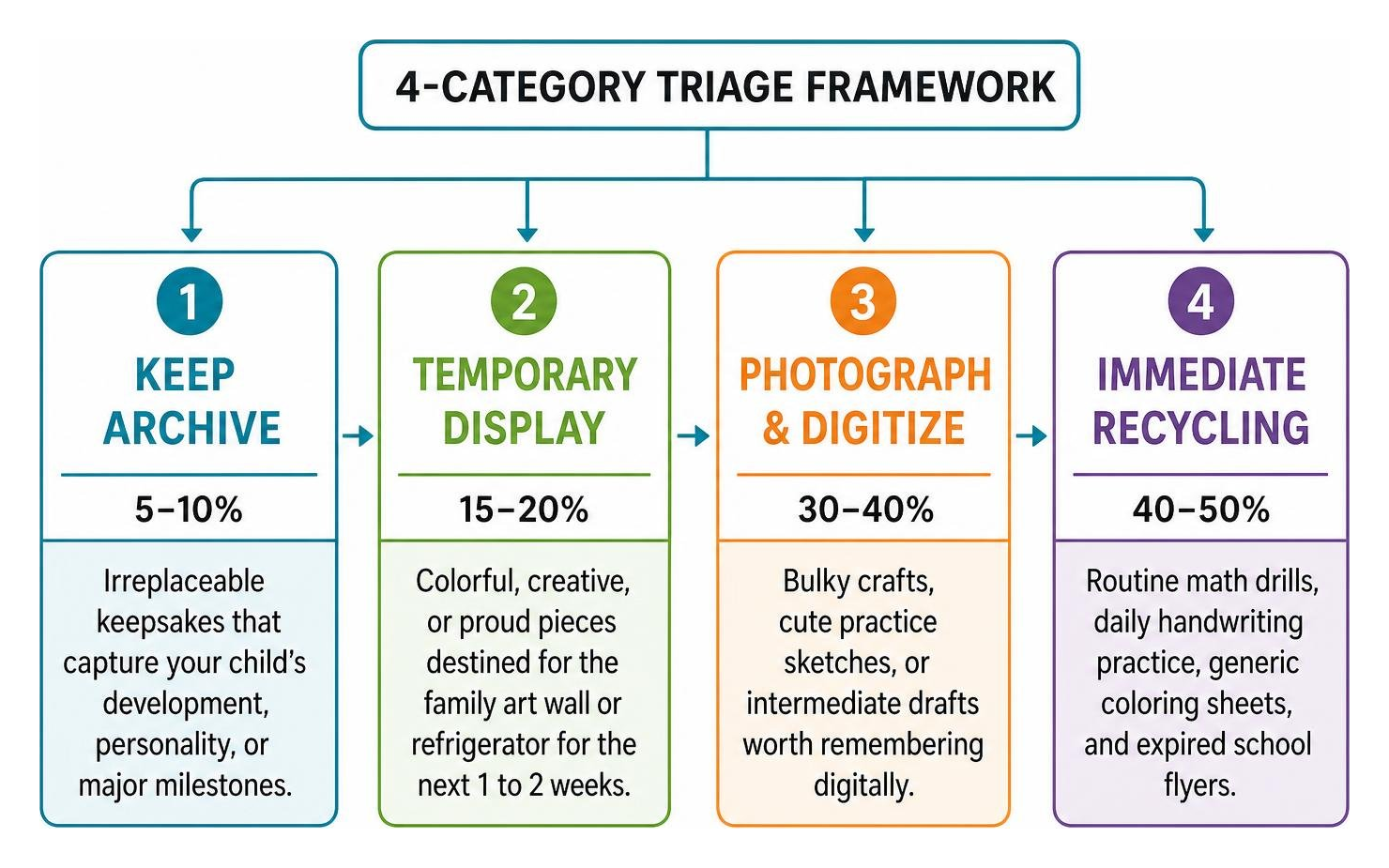
- Keep Archive (5–10%): Irreplaceable keepsakes that capture your child’s development, personality, or major milestones.
- Temporary Display (15–20%): Colorful, creative, or proud pieces destined for the family art wall or refrigerator for the next 1 to 2 weeks.
- Photograph & Digitize (30–40%): Bulky crafts, cute practice sketches, or intermediate drafts worth remembering digitally without taking up physical shelf space.
- Immediate Recycling (40–50%): Routine math drills, daily handwriting practice, generic coloring sheets, and expired school flyers.
Professional organizers agree that only 5% to 10% of total incoming work deserves long-term physical storage. Applying these firm boundaries prevents paper from creeping across your living spaces.
Handling the End-of-Year Paper Flood
In May and June, schools return entire portfolios, workbooks, and art folders all at once. Do not shove these overflowing stacks into a closet to “deal with later.”
Set a kitchen timer for 30 minutes, spread the materials across a clean table, and conduct an annual consolidation. Strip workbooks down to the single most expressive writing sample or the final exam, photograph large poster boards, and recycle the empty binding. This annual reset allows your family to head into summer break completely unburdened by paper clutter.
Deciding What to Keep vs. Toss: Practical Retention Guidelines
Not every pencil stroke is a historic artifact. When evaluating what belongs in the permanent archive, prioritize items that capture authentic character, distinct developmental leaps, or significant academic progress.
| Category | What to Keep (Archive) | What to Display (Temporarily) | What to Digitize (Scan/Photo) | What to Recycle (Immediate) |
|---|---|---|---|---|
| Artwork | Self-portraits, original painted canvases, milestone handprints | Seasonal holiday art, weekly watercolor paintings | 3D clay sculptures, dioramas, oversized poster board projects | Coloring book printouts, scribbles on scrap paper |
| Classwork | Creative stories, personal journals, “About Me” autobiographies | High-scoring science labs, creative poetry pages | Intermediate essay drafts, interesting group project summaries | Daily arithmetic worksheets, spelling practice sheets |
| Assessments | Standardized test summaries, final semester report cards | 100% spelling tests, special certificates of merit | Unit test milestones showing skill acquisition | Daily quizzes, 90% of routine practice tests |
| School Admin | IEP/504 records, formal evaluation files, transcripts | Upcoming event calendars, sports game schedules | Informational school handbooks, volunteer guidelines | Expired event notices, generic PTA flyers, lunch menus |
Understanding educational documentation requirements helps ensure that legal and developmental markers are preserved while routine busywork is safely discarded.
Age-by-Age Breakdown from Preschool to High School
Your archiving strategy should shift as your student advances through the grades:
- Preschool & Kindergarten: Focus on physical development. Preserve handprint and footprint art, first attempts at writing their own name, and self-portraits. Discard generic cut-and-paste worksheets and standard coloring pages.
- Elementary School (Grades 1–5): Keep original creative writing pieces, illustrative drawings that show fine-motor growth, year-end report cards, and standardized test summaries. Recycle roughly 90% of routine math facts and spelling drills.
- Middle School (Grades 6–8): The physical paper trail shrinks as classwork moves online. Preserve major research reports, award certificates, art electives, and final report cards.
- High School (Grades 9–12): Maintain official academic transcripts, standardized testing reports (SAT/ACT/AP), varsity or arts certificates, college application essays, and significant capstone projects.
Archiving Special Education and Legal Records
If your student receives educational accommodations, legal paperwork requires a distinct organizational track. Never mix formal administrative files with sentimental memory boxes.
Maintain a dedicated, heavy-duty binder for all Individualized Education Programs (IEPs), 504 accommodation plans, medical diagnostic letters, formal psychological evaluations, and progress reports. For families navigating public school administration, staying current with CCSD student record guidelines guarantees you retain required legal documentation for annual meetings and district transitions.
Physical and Digital Storage Solutions for School Keepsakes
A sustainable storage system relies on hard physical limits rather than expandable storage totes. When storage space is finite, curation becomes automatic.
When organizing your family’s documents, exploring proven parenting resources and tips can help simplify storage routines and reduce household friction.
Creating a 1-Bin-Per-Child Archive
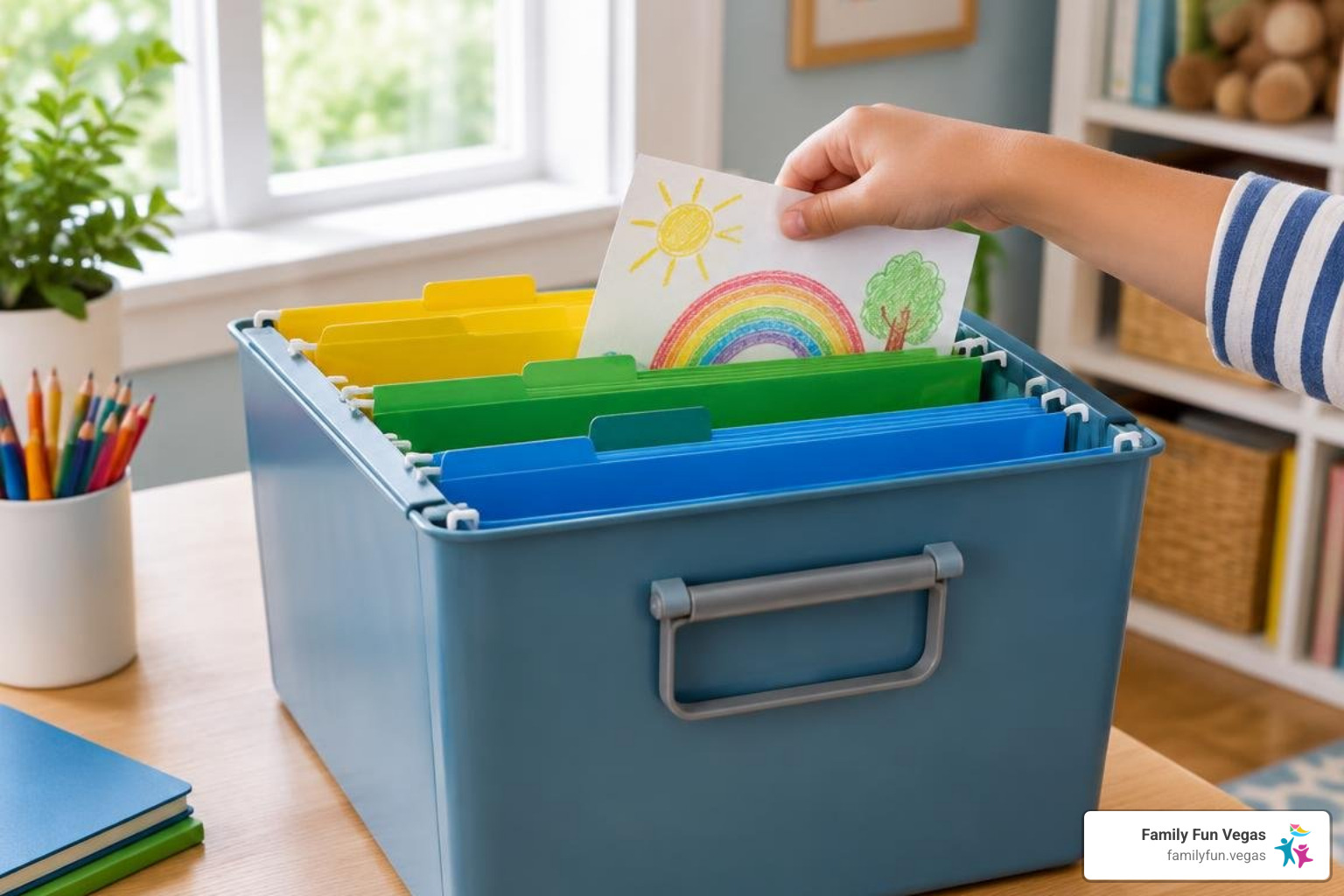
The gold standard for school keepsake storage is the single-bin macro-organization system. Purchase one heavy-duty, waterproof plastic file tote (designed to hold hanging letter files) for each child.
Inside the box, insert 14 labeled hanging folders:
- Preschool / Pre-K
- Kindergarten through 12th Grade (13 individual folders)
- Special Awards & Extracurriculars
Set a hard rule of preserving only 8 to 15 flat paper items per school year. A box that holds approximately 18 inches of hanging files is plenty of physical space to capture an entire childhood from age 3 to 18. When a grade folder is full, you must cull existing items before adding new ones.
Digital Archiving, Cloud Workflows, and Photo Books
Digitization allows you to hold onto memories without keeping physical paper:
- Smartphone Scanning: Use native scanning tools (such as Apple Notes or Google Drive Scan) rather than standard photos to automatically crop, flatten, and correct color.
- Cloud Folder Hierarchy: Establish a dedicated cloud folder organized by year:
Kids Keepsakes > [Child Name] > [Grade Level]. - 3D Art Photography: Photograph bulky clay dioramas, paper mache projects, and oversized posters against a neutral backdrop in natural daylight. Once photographed, discard the physical project guilt-free.
- Annual Keepsake Photo Books: At the end of each school year, upload your scanned photos to a photo book service. In a thin, 20-page hardbound book, you can capture an entire year of artwork, stories, and school milestones that fits neatly on a bookshelf.
Creative Ways to Display, Repurpose, and Involve Kids
Displaying schoolwork validates your child’s hard work, but displays must remain temporary to avoid wall clutter.
- Dynamic Art Frames: Invest in front-opening, spring-loaded art frames that hold up to 50 sheets behind a single glass pane. Swap new art to the front while old pieces store neatly behind it.
- Curtain Wire Art Displays: Hang a stainless steel wire with clips in a playroom or hallway. Children can rotate their current favorite projects independently.
- Upcycling Masterpieces: Repurpose colorful paintings as unique wrapping paper for family birthdays, or trim them down into personalized greeting cards and bookmarks for grandparents.
For more hands-on activities to do together, check out our favorite local family support resources to find engaging family programs across Clark County, Nevada.
Overcoming Sentimental Guilt and Setting Boundaries
Parents often struggle with the emotional weight of letting go. The value of schoolwork lies primarily in the learning process, not the permanent physical product.
Your child gained fine-motor skills, cognitive understanding, and creative confidence in the classroom when making the project. The paper served its educational purpose the moment it was completed. When asked decades later, adult children rarely want boxes of their old elementary spelling tests—they want a curated snapshot of their absolute favorite memories.
Involving Your Child in the Purge Process
Teaching children how to evaluate their own work builds lifelong decluttering skills. If your child struggles with letting go, implement the “Maybe-Keep Basket”:
- Designate a shallow decorative basket in their bedroom for papers they are not ready to recycle.
- Let the papers sit in the basket for 3 to 4 weeks.
- Revisit the basket together. Because the emotional novelty has worn off, children will happily recycle 80% of the contents themselves.
- Give them total ownership over their designated wall display space or single grade-level folder.
Frequently Asked Questions About School Paper Organization
Exactly what do you do with all of the school papers from your child if space is limited?
If physical storage space is minimal, adopt a digital-first archive. Maintain an 18-inch memory box limit across their entire childhood, save only 5 to 10 absolute milestone documents physically, and digitize the rest into annual cloud albums or slim printed photo books.
What do you do with all of the school papers from your child when they want to keep everything?
Use the “Maybe-Keep Basket” method. Avoid arguing or secretly recycling items in front of them. Let papers rest in a transition bin for one month. When you review the bin together later, praise their decision-making skills as they choose their top 2 favorite pieces and release the rest.
How long should you keep standard report cards and standardized test results?
Keep final year-end report cards permanently in their grade-level hanging folder as an academic record. Routine mid-term progress reports can be safely recycled once the final semester grade is posted. Retain high school transcripts and standardized college entrance exam results permanently.
Conclusion
Managing school paperwork does not require complex organizing systems or endless plastic bins. By putting a quick daily routine in place, sorting papers weekly with the 4-category triage method, and sticking to a 1-bin limit per child, you can permanently conquer paper clutter. You will protect your home from the paper avalanche while building a curated collection of childhood memories your family will cherish forever.
Looking for creative ways to inspire your young creators this weekend? Explore our curated directory of hands-on family craft events across Las Vegas and Henderson for fun workshops and artistic activities.