

20 Best Halloween Science Experiments for Kids
The best Halloween science experiments for kids turn spooky holiday themes into exciting, hands-on learning moments. Top activities like erupting pumpkin volcanoes, fizzy ghost rockets, static electricity specters, and Skittles candy diffusion let children explore core chemistry, physics, and biology using simple household supplies. When October arrives across the Las Vegas valley, tying STEM concepts to festive themes boosts engagement and makes science lessons stick.
To help you choose the right project for your home or classroom, we have compiled 20 fantastic experiments covering core areas of chemistry, physics, biology, and engineering.
| Experiment | Core Concept | Prep Time | Difficulty Level |
|---|---|---|---|
| Jack-o’-Lantern Volcano | Catalase decomposition / Exothermic reactions | 10 mins | Easy |
| Puking Pumpkin | Acid-base gas production | 10 mins | Easy |
| Bubbling Witch Cauldron | Gas expansion & foam generation | 5 mins | Easy |
| Fizzy Ghost Rockets | Gas pressure & Newton’s 3rd Law | 5 mins | Medium |
| Static Electricity Ghosts | Electron transfer & electrostatic force | 5 mins | Easy |
| Flying Tea Bag Specters | Thermal convection & air density | 5 mins | Medium |
| Monster Eye Density Jar | Immiscible liquids & buoyancy | 10 mins | Easy |
| Dancing Gummy Worms | Acid-base reactions & buoyancy shifts | 25 mins | Easy |
| Skittles Pumpkin Diffusion | Concentration gradients & solubility | 5 mins | Easy |
| Candy Corn Chromatography | Capillary action & pigment separation | 10 mins | Easy |
| Microwave Peep Monsters | Thermal gas expansion & state changes | 5 mins | Easy |
| Growing Gummy Bears | Osmosis & water potential | 5 mins (overnight) | Easy |
| Edible Candy Rock Cycle | Geological transformations (heat/pressure) | 15 mins | Easy |
| Candy DNA Helix Model | Molecular biology structures | 15 mins | Medium |
| Frankenstein LED Paper Circuit | Electrical currents & closed circuits | 20 mins | Medium |
| Borax Crystal Spiders | Supersaturation & crystallization | 15 mins (overnight) | Medium |
| Glow-in-the-Dark Slime | Polymer cross-linking & phosphorescence | 10 mins | Easy |
| Pumpkin Guts Oobleck | Non-Newtonian fluid dynamics | 10 mins | Easy |
| Articulated Skeleton Hand | Tendon anatomy & mechanical pull | 20 mins | Medium |
| Candy Corn Catapult | Trajectory physics & potential energy | 15 mins | Medium |
Erupting Pumpkin Chemistry and Foaming Potions
Nothing kicks off spooky season quite like a dramatic, bubbling eruption pouring from a carved face. You can explore exciting pumpkin volcano science experiments using either classic pantry staples or a rapid yeast reaction.
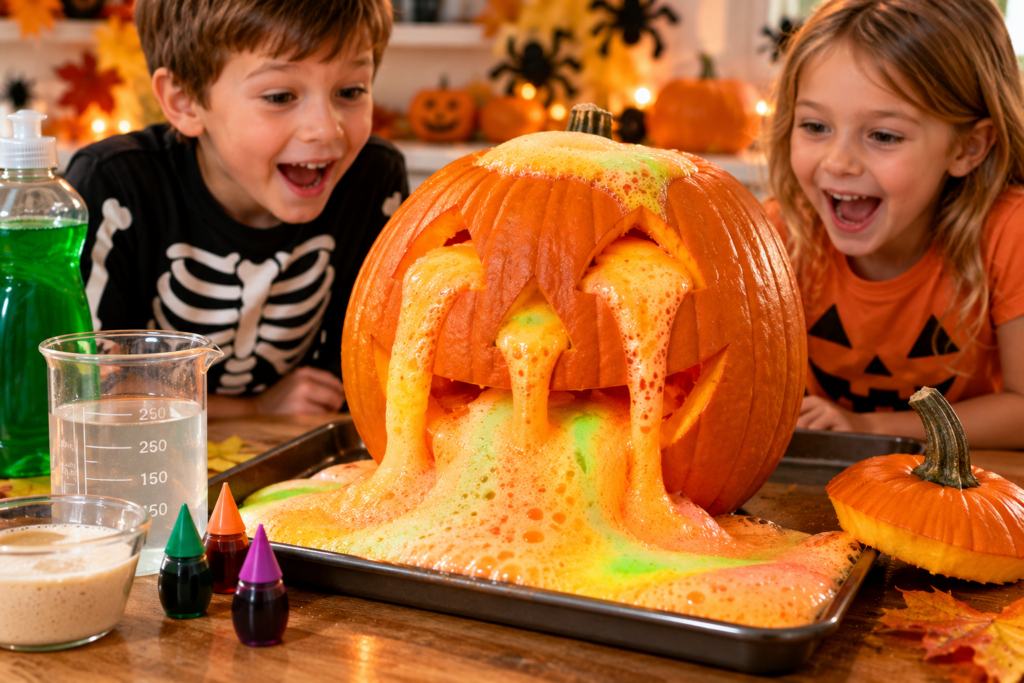
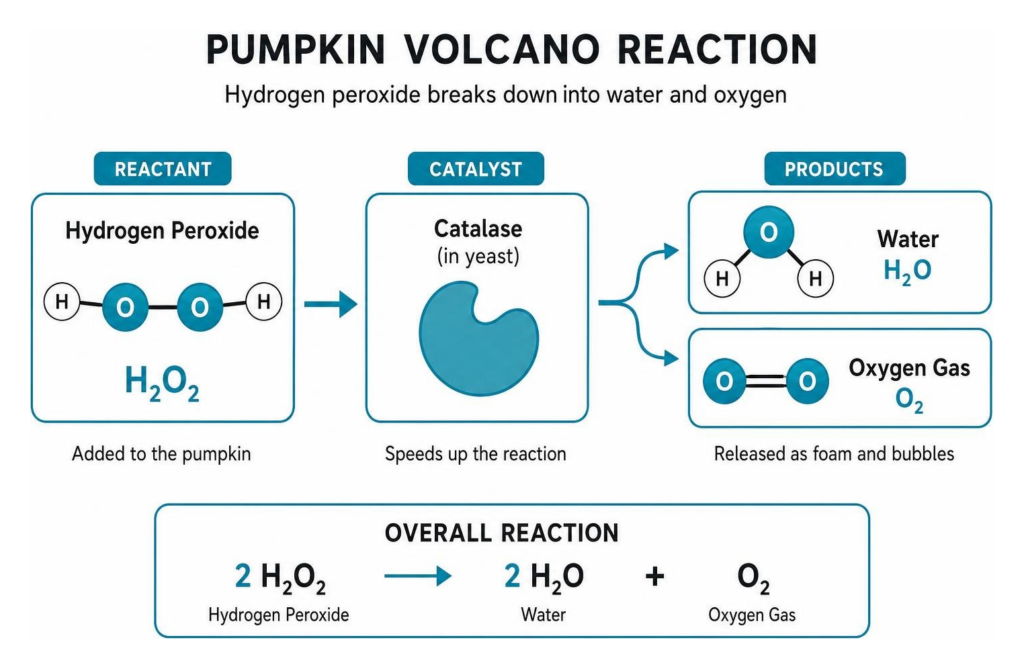
- The Classic Yeast & Peroxide Pumpkin Volcano: Place a small glass beaker inside a carved pumpkin. Add 1/2 cup of 3% to 6% hydrogen peroxide, a generous squirt of liquid dish soap, and several drops of neon food coloring. In a separate cup, stir one packet of active dry yeast into 3 tablespoons of warm water (around 105°F) and let it sit for two minutes. Pour the yeast mixture into the pumpkin and watch thick, warm foam surge out of the carved eyes, nose, and mouth. This reaction demonstrates the enzyme catalase in yeast breaking hydrogen peroxide ($H2O2$) into water ($H2O$) and oxygen gas ($O2$). Because the reaction releases thermal energy, kids can safely feel the warmth radiating from the foam.
-
The “Puking Pumpkin” Acid-Base Reaction: For younger learners, you can swap peroxide for baking soda and vinegar. Place 4 tablespoons of baking soda and a squirt of green dish soap inside a pumpkin. When you pour in a cup of white vinegar (acetic acid), sodium bicarbonate neutralizes the acid, rapidly producing carbon dioxide ($CO_2$) gas bubbles trapped by the dish soap.
-
Bubbling Witch’s Cauldron: In a small plastic cauldron or clear glass beaker, add 2 tablespoons of baking soda, dish soap, green food coloring, and a sprinkle of biodegradable glitter. When kids slowly pour in vinegar, the resulting foam creates a shimmering potion straight out of a mad science laboratory.
Spooky Physics, Density, and Ghost Motion
Physics brings Halloween creations to life without any actual supernatural intervention!
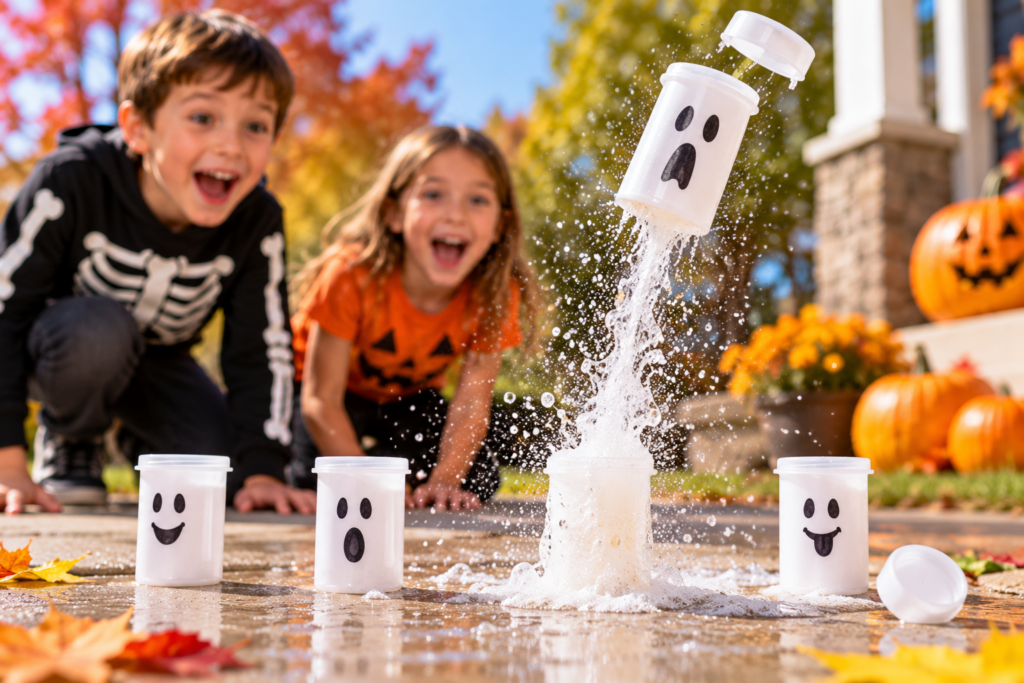
4. Fizzy Ghost Rockets: Take your mini-scientists outside for this high-flying project. Using an empty film canister or plastic snap-top container, turn it upside down and draw a ghost face on the side with a permanent marker. Add 1 teaspoon of water into the canister, drop in one-half of an effervescent antacid tablet (or a combination of baking soda and vinegar), snap the lid on tightly, place it upside-down on a flat surface, and step back three paces. In seconds, the expanding $CO_2$ gas builds pressure against the container walls until the cap bursts off, launching the rocket several feet into the air. Learn the step-by-step setup with this fizzy ghost rockets STEM project.

5. Static Electricity Ghosts: Cut small ghost shapes out of lightweight tissue paper. Blow up a standard latex balloon and rub it vigorously against your hair, a wool sweater, or a fleece blanket for 15 seconds. Hold the balloon about an inch above the tissue ghosts. The negative electric charges (electrons) collected on the balloon attract the neutral paper, making the ghosts dance, jump, and levitate.
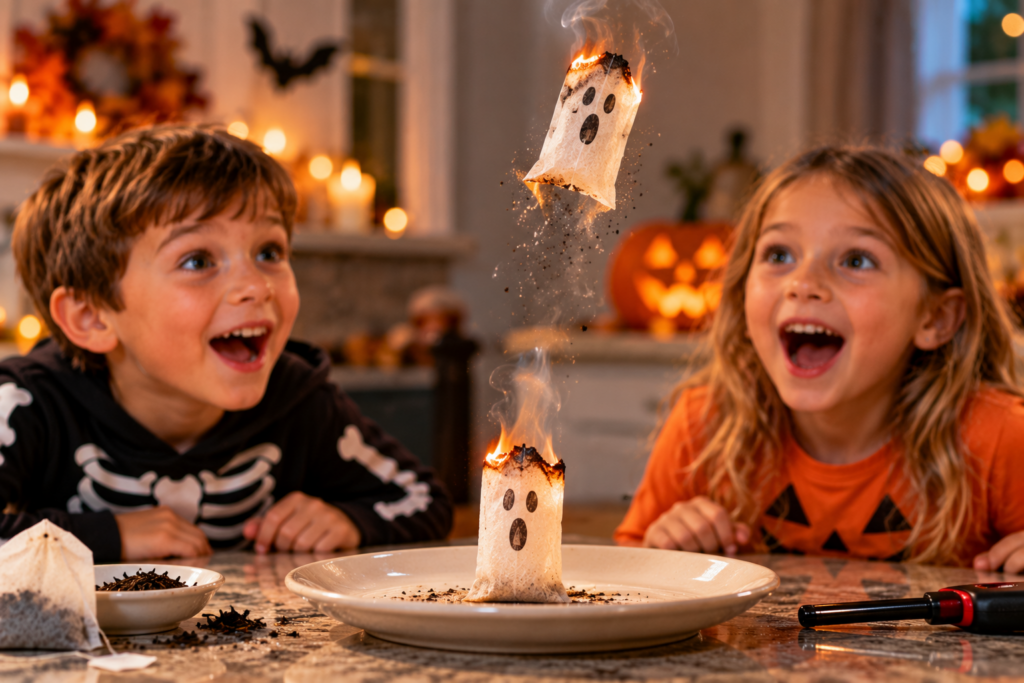
6. Flying Tea Bag Specters: Under strict adult supervision, empty a single tea bag, unroll the cylinder, and stand it upright on a heat-safe ceramic plate. Use a lighter or match to ignite the top rim. As the tea bag burns down, it heats the air inside the hollow cylinder. Warm air is less dense than the surrounding cool air, creating an upward thermal convection current. As the ash becomes ultra-light, the rising warm air carries the glowing ghost structure straight up toward the ceiling before cooling and falling gently back down.
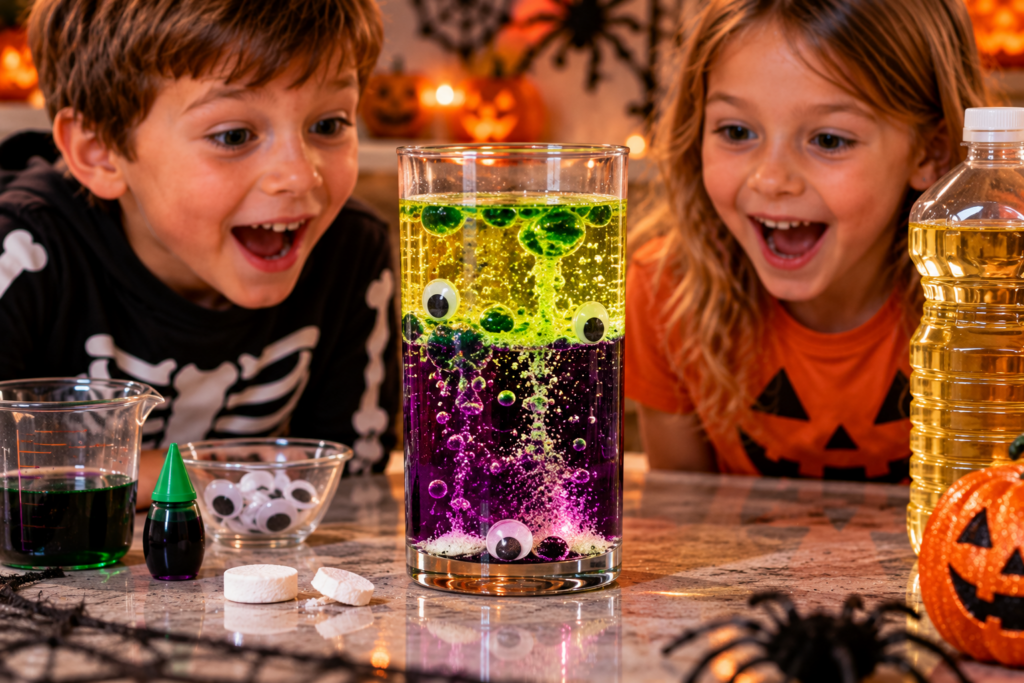
7. Monster Eye Density Jar: Fill a tall, clear glass halfway with regular vegetable oil. In a small cup, tint water with dark green or purple food coloring. Pour the water into the oil. Because water is polar (hydrophilic) and denser than non-polar vegetable oil (hydrophobic), the liquids stay separated. Drop in a couple of plastic googly eyes (or small foam beads) and observe where they settle between the liquid boundaries. Drop in a quarter of an antacid tablet to create colorful rising and falling droplets, turning the container into a DIY Halloween lava lamp.
Sweet Candy Science and Edible Reactions
Put that leftover trick-or-treat haul to good educational use with these delicious experiments.
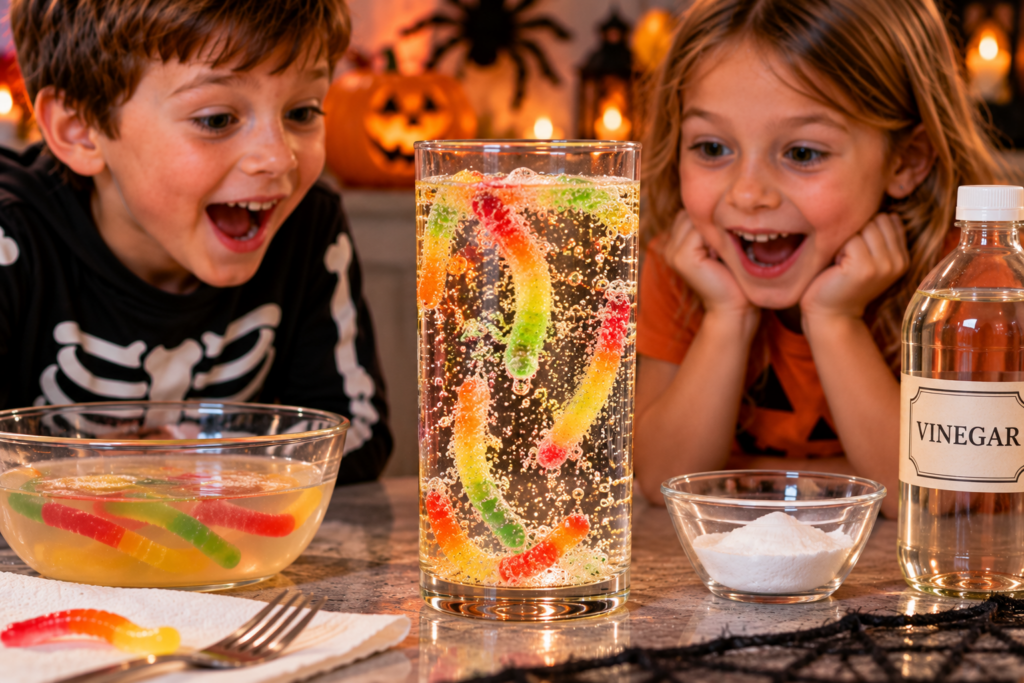
8. Dancing Gummy Worms: Cut gummy worms lengthwise into four thin, slender strips. Soak the worm strips in a bowl containing 3 tablespoons of baking soda dissolved in 1 cup of warm water for 20 minutes. Using a fork, transfer the soaked worms into a tall glass filled with plain white vinegar. The vinegar immediately reacts with the baking soda soaked into the candy, forming tiny $CO_2$ bubbles across the gummy skin. As bubbles attach, they lower the worm’s overall density, pulling it to the surface. When the bubbles pop in the air, the worm sinks back down, repeating the cycle. Check out this dancing gummy worms experiment guide to see the full setup.
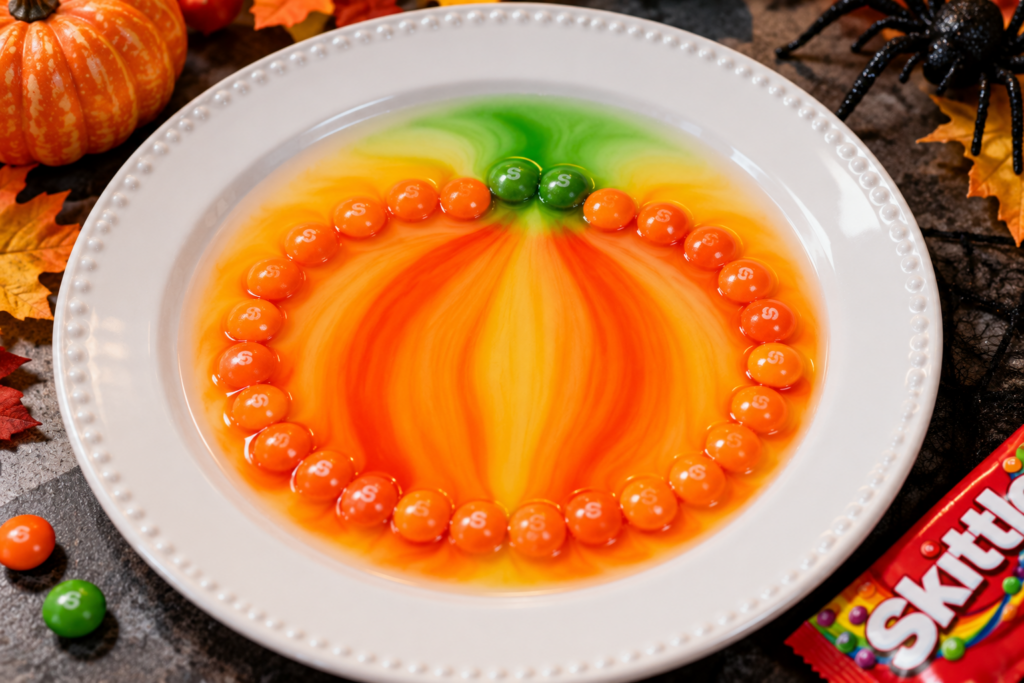
9. Skittles Pumpkin Diffusion: Arrange orange Skittles in a wide circle on a white rimmed dinner plate, adding two green Skittles at the top to form a stem. Gently pour warm water into the center of the plate until it touches the candies. The sugar and food dye dissolve and diffuse outward along a concentration gradient, moving from areas of high sugar concentration to low concentration. Because water currents stay calm on a flat plate, the colors meet without instantly mixing, creating a crisp, vibrant pumpkin pattern.
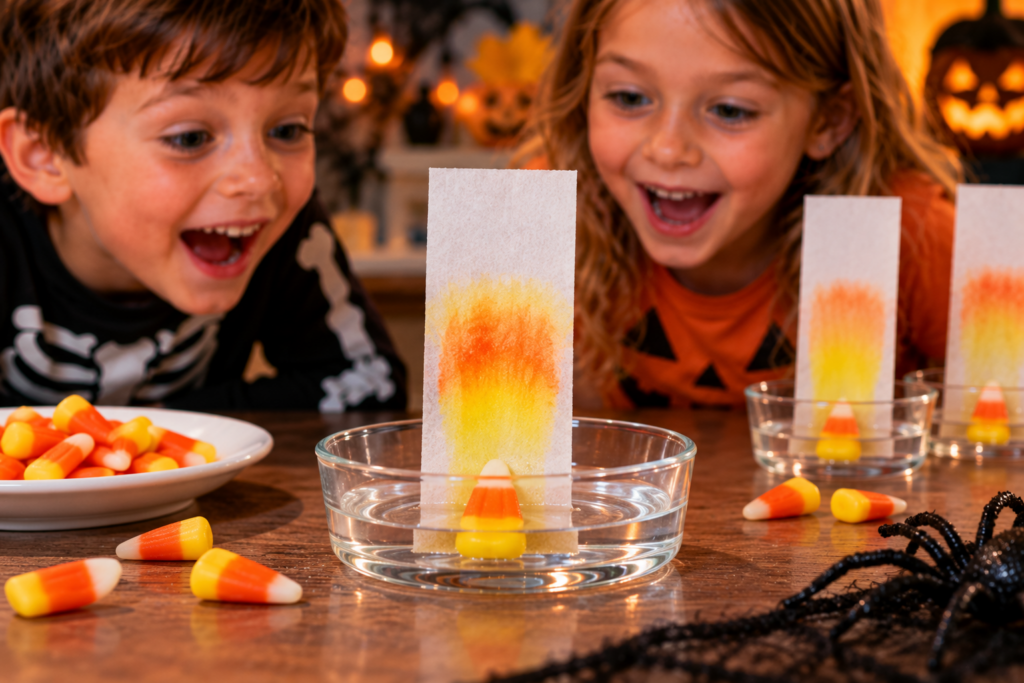
10. Candy Corn Chromatography: Place a piece of candy corn in a shallow dish with a tablespoon of water. Dip the bottom edge of a strip of coffee filter paper into the liquid. As water travels up the paper fibers via capillary action, it separates the yellow and orange dyes based on molecular size and solubility.
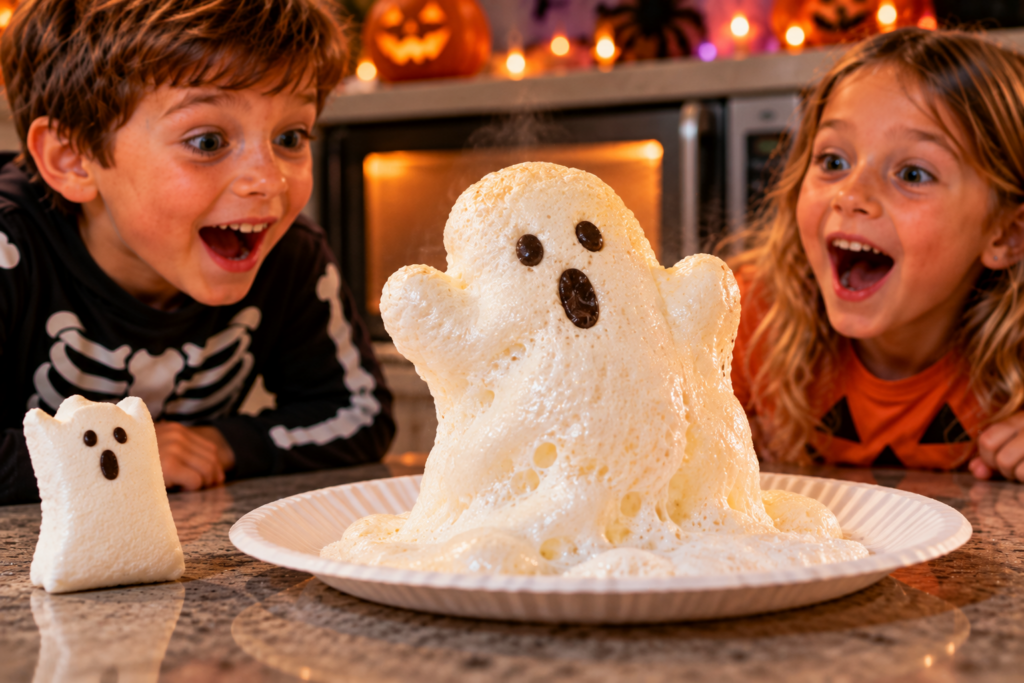
11. Microwave Peep Monsters: Place a marshmallow Peep ghost on a microwave-safe paper plate. Heat it on high for 30 seconds. Marshmallows are filled with trapped air pockets and moisture. As microwaves heat the water molecules, the air pockets expand, and the sugar structure softens, causing the Peep to swell into a giant monster before deflating as it cools.
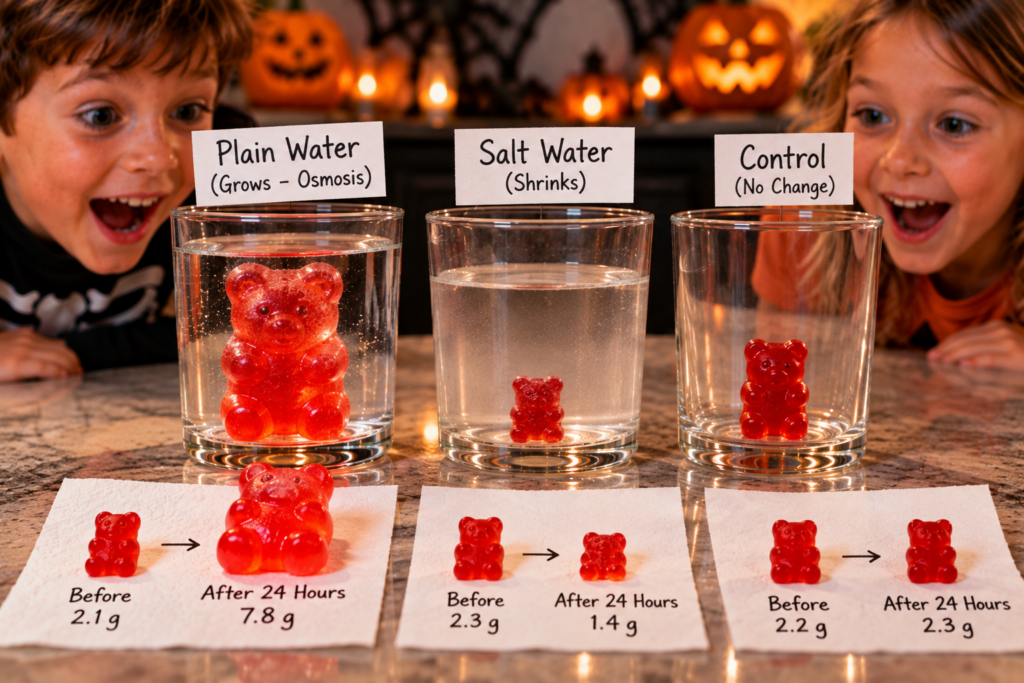
12. Growing Gummy Bears (Osmosis): Measure and weigh three gummy bears. Place one in plain tap water, one in salt water, and keep one dry as a control. Over 24 hours, the gummy bear in plain water will expand dramatically due to osmosis, as water molecules pass through the semi-permeable gelatin matrix into the hypertonic candy interior.
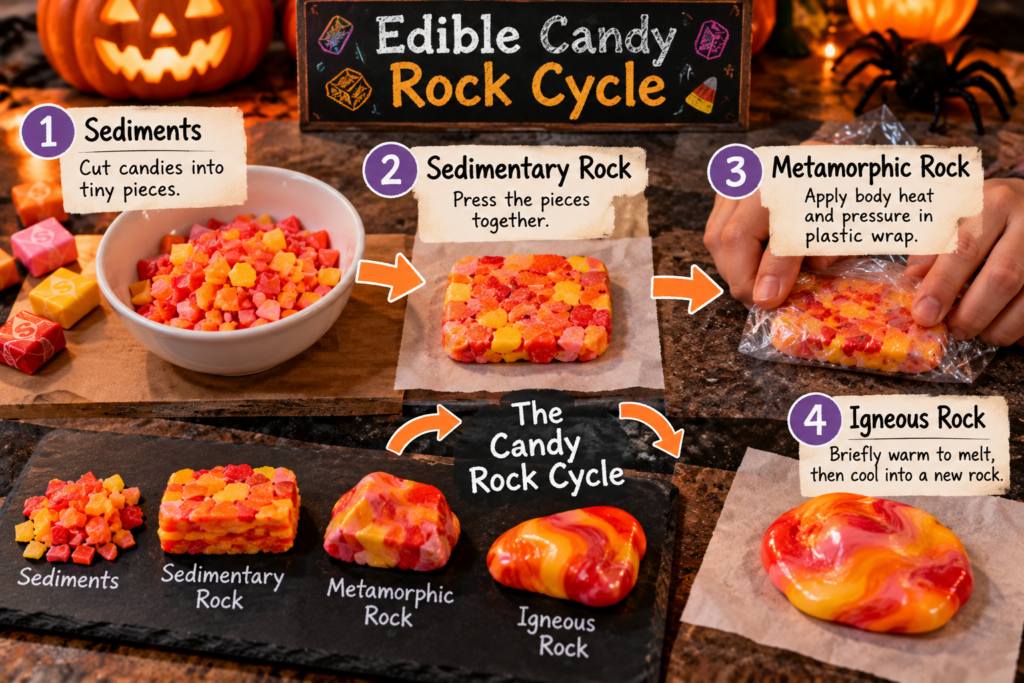
13. Edible Candy Rock Cycle: Use soft candies (such as Starburst) to model geology. Cut candies into tiny pieces to represent sediments, press them together to form sedimentary rock, apply body heat and pressure in plastic wrap for metamorphic rock, and briefly warm them to melt and cool into igneous candy rock.
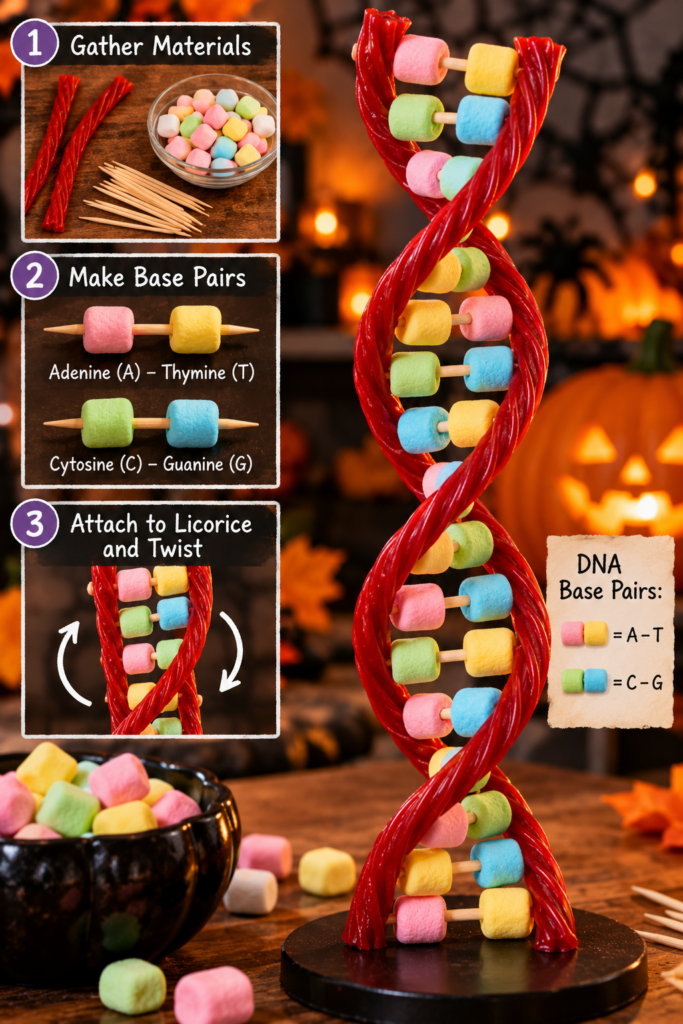
14. Candy DNA Helix: Use two licorice strands as the sugar-phosphate backbone and colored mini-marshmallows or soft candies attached with toothpicks to represent complementary nitrogenous base pairs (adenine with thymine, cytosine with guanine). Twist the ladder to form a double helix.
Monster Lab STEM, Crystals, and Electrical Circuits
Combine engineering, structural design, and molecular chemistry to craft your own high-tech spooky lab.
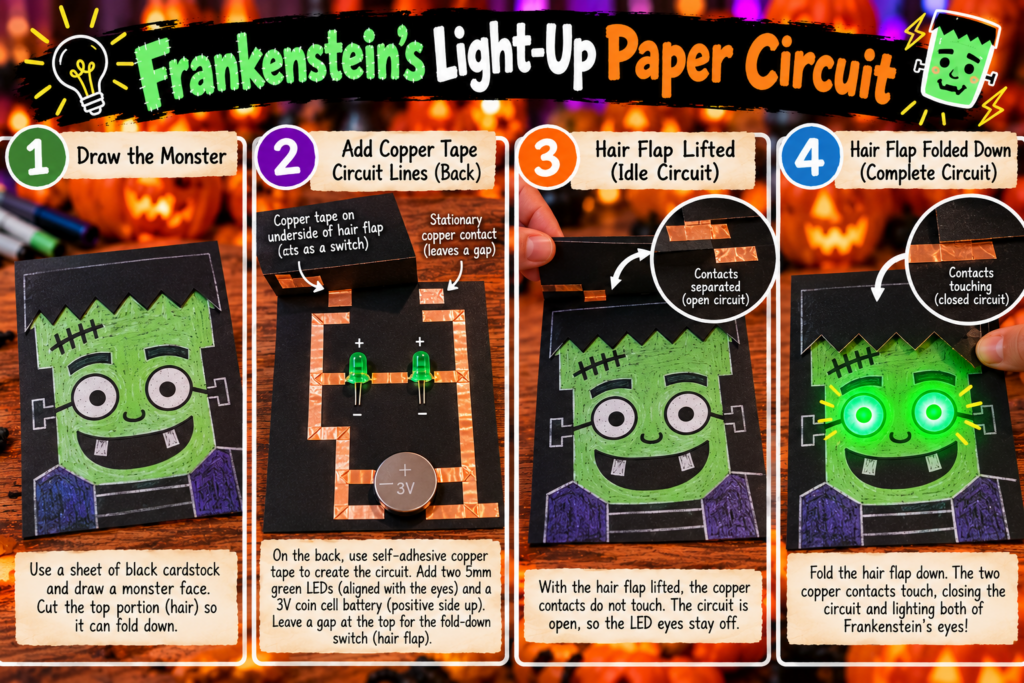
15. Frankenstein’s Light-Up Paper Circuit: Using a sheet of black cardstock, draw a monster face. Lay self-adhesive copper tape along positive and negative circuit lines, bridging a gap with a 5mm green LED bulb and powering it with a 3V coin cell battery. When kids fold the corner of the paper down to complete the circuit, Frankenstein’s eyes glow brightly, teaching the fundamentals of electrical currents. Families who love this hands-on engineering can also register for interactive youth science musketeers workshops right here in our local area to continue building practical STEM skills.
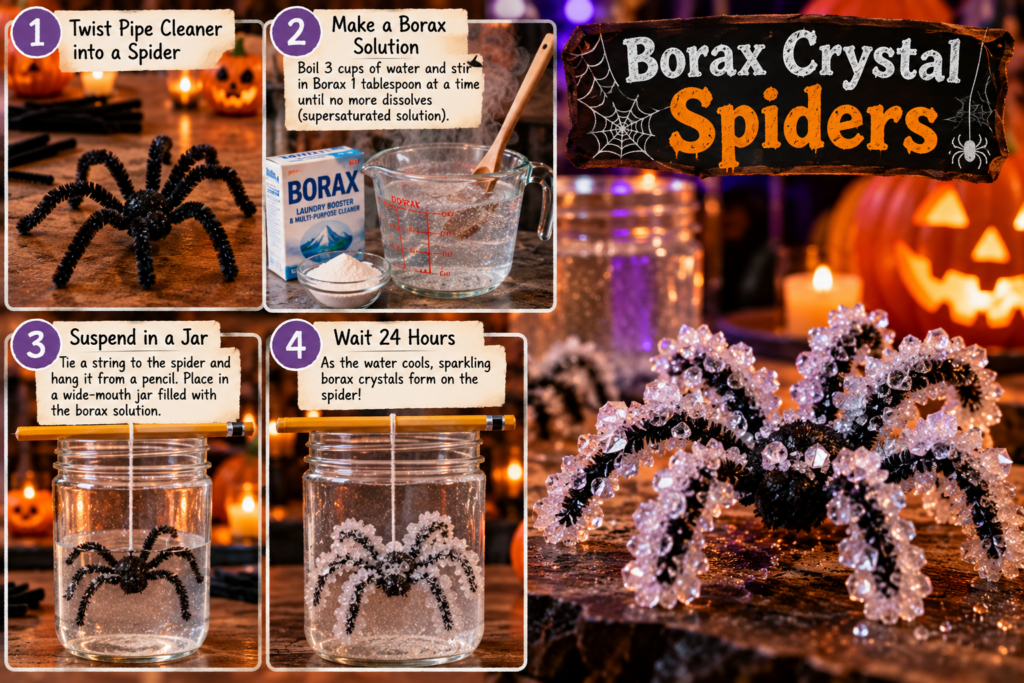
16. Borax Crystal Spiders: Twist black pipe cleaners into eight-legged spiders. Boil 3 cups of water and stir in Borax powder one tablespoon at a time until no more dissolves, creating a supersaturated solution. Suspend the pipe cleaner spider from a pencil into a wide-mouth jar filled with the solution, ensuring it doesn’t touch the sides. As the water cools over 24 hours, the water molecules can no longer hold the dissolved minerals, precipitating sparkling mineral crystals across the spider legs.
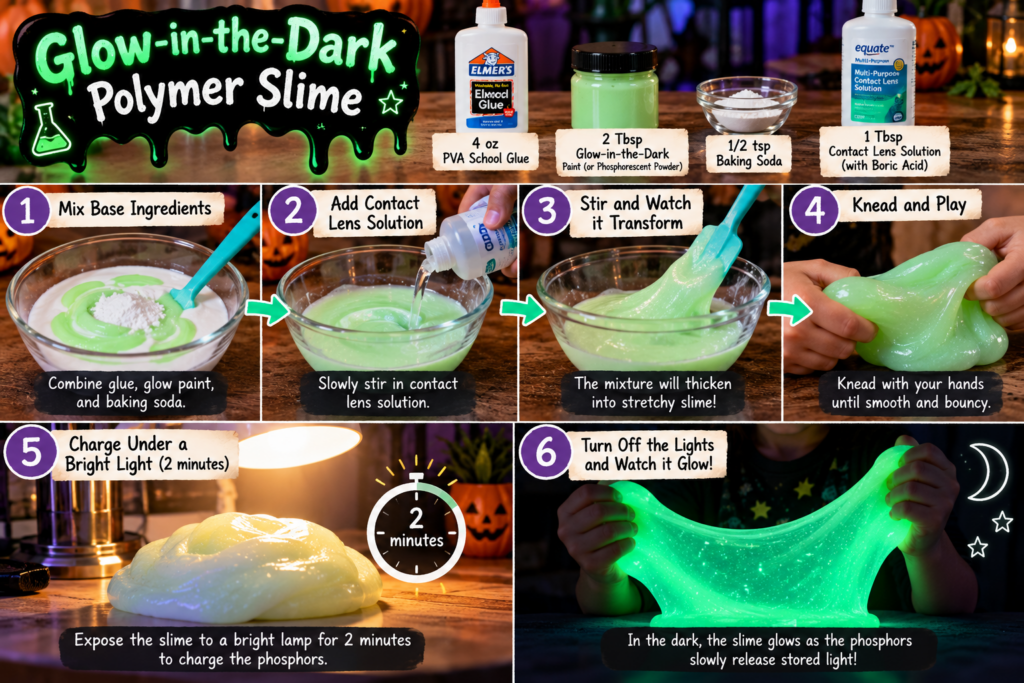
17. Glow-in-the-Dark Polymer Slime: Mix 4 ounces of clear or white PVA school glue with 2 tablespoons of glow-in-the-dark paint (or phosphorescent powder) and 1/2 teaspoon of baking soda. Slowly stir in 1 tablespoon of contact lens solution containing boric acid. The borate ions cross-link the long polymer chains of polyvinyl alcohol, turning sticky liquid glue into a stretchy, bouncy solid. “Charge” the slime under a bright lamp for two minutes, turn off the lights, and watch the phosphors slowly release stored light photons!
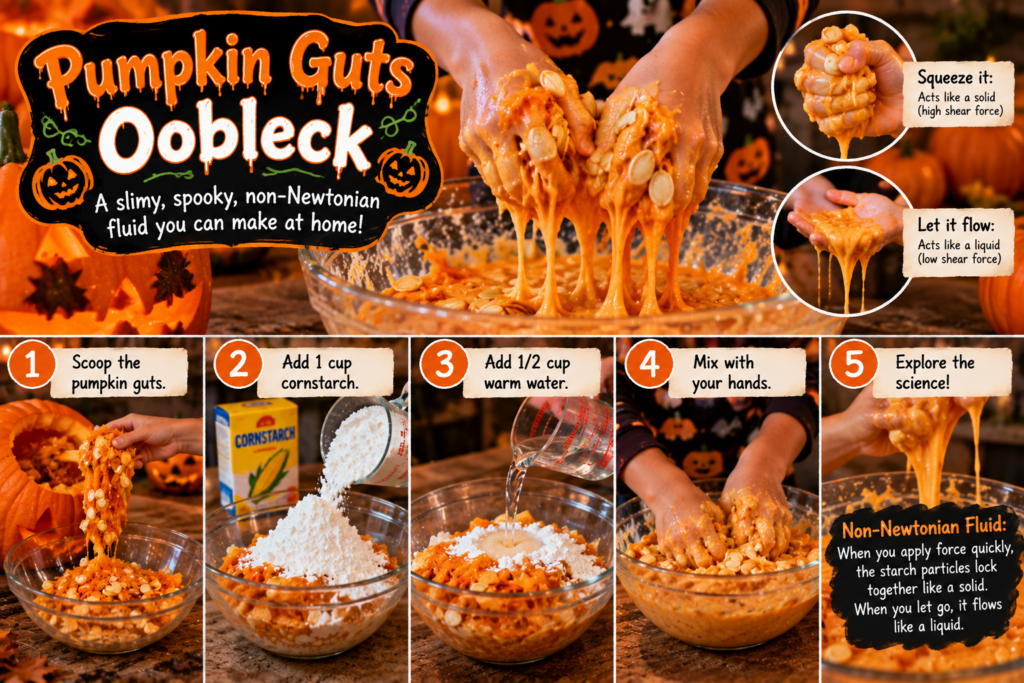
18. Pumpkin Guts Oobleck: Empty the stringy guts and seeds from a carved pumpkin into a large bowl. Add 1 cup of cornstarch and 1/2 cup of warm water. Mix with your hands to create a classic non-Newtonian fluid. When squeezed with high shear force, the starch particles lock together like a solid; when held gently, the pumpkin slime flows through your fingers like a liquid.
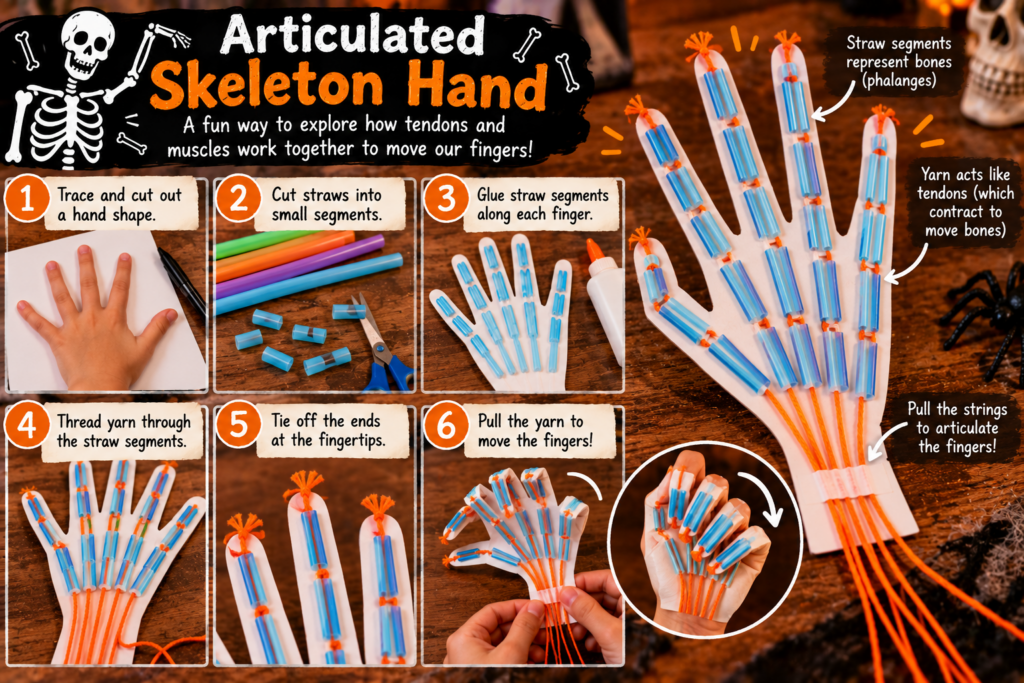
19. Articulated Skeleton Hand: Trace a child’s hand on white poster board and cut it out. Cut plastic drinking straws into small segments representing phalanges and glue them along each finger bone. Thread pieces of yarn through the straw segments and tie them off at the fingertips. Pulling on individual yarn strings mimics the action of human tendons contracting muscles to articulate bones.
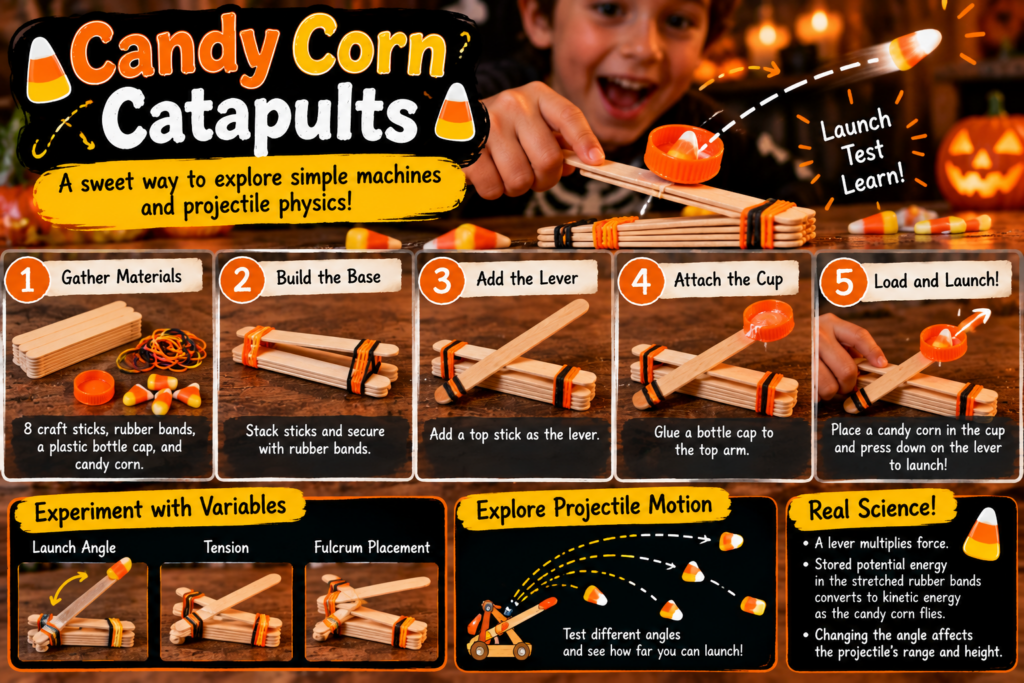
20. Candy Corn Catapults: Build a simple lever machine using 8 craft popsicle sticks bound with rubber bands and a plastic bottle cap glued to the top arm. Children test launch angles, tension, and fulcrum placements to launch candy corn across the room, analyzing projectile physics and potential-to-kinetic energy conversion.
Essential Safety Protocols and Scientific Method Guide
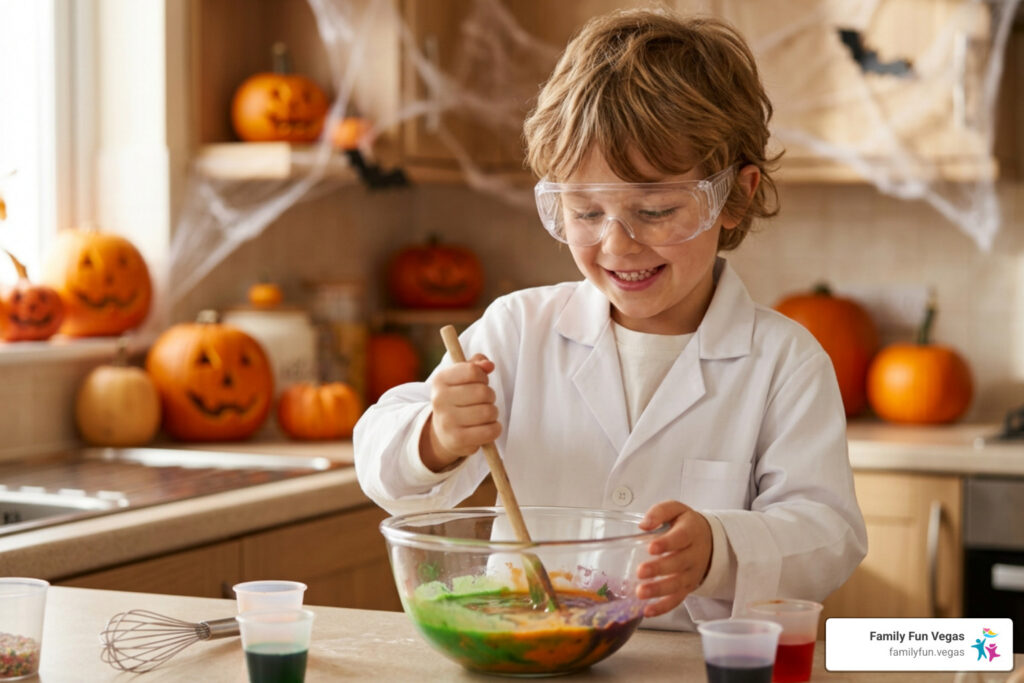
Transforming your home or classroom into a spooky laboratory requires smart safety habits. With basic safety protocols in place, kids can experiment confidently without unnecessary mess or risk.
Lab Safety and Dry Ice Handling Rules
Dry ice ($CO_2$ in solid form at $-109.3^\circ\text{F}$ or $-78.5^\circ\text{C}$) is a staple for spooky fog effects, but it demands strict adult management.
- Never Touch with Bare Hands: Solid carbon dioxide causes severe thermal frostbite within seconds of direct skin contact. Adults should always handle dry ice using insulated leather or thick silicone oven mitts along with heavy-duty tongs.
- Maintain Proper Ventilation: Sublimation turns dry ice directly into invisible carbon dioxide gas. In enclosed, poorly ventilated spaces, $CO_2$ pools in low areas and can displace oxygen. Always conduct dry ice experiments in open rooms with cross-ventilation or outdoors.
- Never Seal in Airtight Containers: When dry ice sublimes, the expanding gas creates immense pressure. Placing dry ice in a sealed glass jar, thermos, or screw-top plastic bottle creates an explosion hazard. Always leave lids completely loose to let gas escape.
- General Chemistry Safety: Provide kids with properly fitting safety goggles during any experiment involving fizzing chemicals or elastic tension. Use disposable plastic trays or shallow baking dishes underneath containers to catch bubbling overflows.
Applying the Scientific Method to Spooky STEM
To make these Halloween projects genuinely educational, frame every experiment around the scientific method:
- Ask a Question: “Will a pumpkin float in water?” or “Does warm water make colors diffuse faster than cold water?”
- Form a Hypothesis: Encourage kids to state their prediction clearly: “If I use warm water, then the Skittles will dissolve faster because heat increases molecular movement.”
- Conduct the Test & Control Variables: Change only one variable at a time (e.g., water temperature) while keeping everything else identical (plate size, candy count, water volume).
- Record Observations: Have students sketch before-and-after pictures or log time stamps in a science notebook.
- Draw Conclusions: Discuss whether the collected data supported the initial hypothesis and why.
If your children enjoy applying systematic problem-solving to earth science and hands-on discovery, consider checking out Minecraft geology and rock exploration sessions designed to make earth sciences exciting for young learners.
Adapting Halloween Science Experiments for Kids Across Grade Levels
Every age group approaches science differently. Adjusting your experiments to match developmental levels ensures every child stays engaged without feeling frustrated.
Preschool to Kindergarten Sensory Investigations
Early learners thrive when engaging their senses through tactile, visual exploration. Focus on open-ended observation rather than rigid formulas.
- Sensory Density Testing: Fill a clear plastic tub with water and let preschoolers test whether mini pumpkins, plastic spiders, leaves, and foam eyeballs sink or float.
- Pumpkin Seed Math & Texture Play: Scoop out pumpkin seeds, sort them by size, and practice counting by fives and tens while feeling the wet fibrous textures.
- Color Mixing Potions: Provide droppers filled with yellow, blue, and red vinegar, letting little learners drop them into baking soda muffin tins to discover secondary colors through fizzy exploration.
Hands-on sensory tasks build early fine motor skills. For more tactile building fun, check out STEAM Wednesday play dough building challenges to keep little hands building and learning all year long.
Elementary and Middle School Engineering Challenges
Older students are ready for quantitative measurements, controlled variables, and structural design challenges.
- Bone Bridge Load Distribution: Give students 20 craft sticks and 10 pipe cleaners. Challenge them to build a freestanding bridge span that can support the weight of a 2-pound pumpkin without collapsing, exploring load paths and structural triangles.
- Pumpkin Zip Lines: Using string, paper cups, and plastic pulleys, challenge kids to design a gravity-driven transport system that safely carries candy pumpkins from a high shelf to a table target.
- Quantitative Chromatography & Reaction Timing: Have middle schoolers use stopwatches to measure reaction rates when altering vinegar concentrations or testing water temperatures with effervescent rockets.
Inclusive Fall STEM Alternatives and Home Setup
Not every family or classroom celebrates Halloween, but autumn provides plenty of seasonal science opportunities that everyone can enjoy.
Non-Halloween Fall Science Alternatives
You can easily shift the focus toward harvest biology, botany, and autumn weather patterns:
- Autumn Leaf Chromatography: Collect fallen red, orange, yellow, and green leaves. Grind them in rubbing alcohol, place a coffee filter strip inside the jars, and watch the pigments separate, revealing how carotenoids and anthocyanins emerge as green chlorophyll breaks down in fall.
- Apple Oxidation Testing: Slice fresh apples and place slices in lemon juice, vinegar, plain water, and milk to observe which liquid best inhibits polyphenol oxidase enzymes from browning the fruit.
- Cranberry pH Indicators: Boil fresh cranberries in water to create a deep red indicator liquid. Adding baking soda turns it dark blue/green (alkaline), while adding lemon juice restores the bright pink/red hue (acidic).
Easy Halloween Science Experiments for Kids at Home
You don’t need a formal laboratory to conduct fantastic STEM projects. Your home kitchen is already stocked with everything required for successful scientific inquiry:
- Set Up a Mess-Free Zone: Work on large rimmed cookie sheets or shallow plastic storage bins to catch spills effortlessly.
- Pantry-First Approach: Keep distilled white vinegar, baking soda, cornstarch, food coloring, and dish soap handy for quick weekend experiments.
- Collaborative Family Nights: Set up two or three stations at a weekend gathering where siblings can test hypotheses together.
If you are looking for more festive outdoor community fun around town, you can explore spooky trunk-or-treat community activities for safe, family-friendly evening entertainment.
Frequently Asked Questions About Halloween Science
What are the easiest Halloween science experiments with minimal supplies?
The simplest low-prep activities are Static Electricity Ghosts (requiring only a balloon and tissue paper), the Skittles Pumpkin Diffusion (needing only candy, a plate, and warm water), and the Baking Soda & Vinegar Cauldron (using basic kitchen staples). All three take under five minutes to set up and deliver immediate visual results.
How do you safely handle dry ice around young children?
Dry ice should strictly be handled by adults wearing insulated, heavy-duty gloves and using metal or silicone tongs. Keep the dry ice in an open, well-ventilated room to prevent carbon dioxide buildup, and never place dry ice pieces inside sealed, airtight containers or drink glasses where it could accidentally be swallowed.
What scientific concept is demonstrated by pumpkin volcanoes?
A yeast-based pumpkin volcano demonstrates an enzymatic decomposition and exothermic reaction. The catalase enzyme present in active dry yeast rapidly breaks down hydrogen peroxide ($H2O2$) into water and oxygen gas. When mixed with dish soap, the released oxygen creates billions of tiny foam bubbles, while the reaction naturally releases heat.
Conclusion
Spooky season offers the ultimate excuse to swap regular worksheets for bubbling beakers, flying ghosts, and fizzy pumpkin eruptions. By connecting foundational chemistry, physics, and engineering concepts to festive autumn themes, you can turn seasonal excitement into genuine curiosity and critical thinking.
At Family Fun Vegas, our mission is to help local families discover the best family-friendly events, creative learning workshops, and memorable activities across the valley. Whether you’re turning your kitchen table into a mad scientist lab this weekend or exploring creative family fun crafts and workshops around town, hands-on learning is always the best way to spark a lifelong love of discovery. Gather your safety goggles, round up a few pumpkins, and enjoy discovering the wonderful world of science with your kids!